
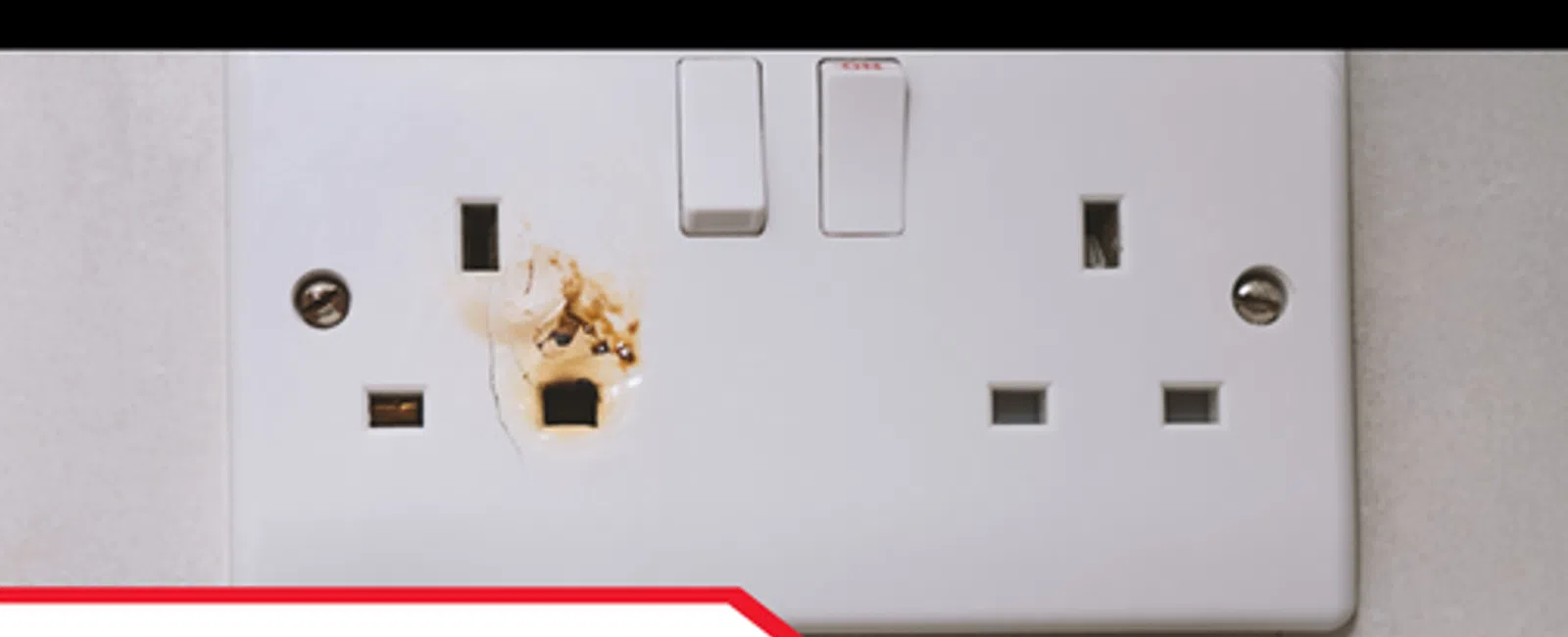
Electrical receptacles are among the most frequently used components in a home, yet they are also easy to overlook. Homeowners plug in lamps, chargers, appliances, televisions, and other devices without giving much thought to the outlet itself. As long as the device receives power, it can be tempting to assume everything behind the receptacle is functioning as intended. Visible changes around an outlet, however, can provide important clues that something deserves further attention.
Licensed and Certified Inspector Erik J. of LunsPro Inspection Group observed an electrical receptacle with visible burn marks during an inspection. An unusual electrical sound could also be heard while the receptacle was being checked. Those two observations are important because neither scorching nor abnormal electrical sounds should simply be considered a normal characteristic of an outlet. The image alone does not establish exactly what caused the condition, so determining the underlying electrical issue would require appropriate professional evaluation.
For homeowners throughout Nashville, Chattanooga, Atlanta, Charlotte, Raleigh, Greensboro, Greenville, Savannah, and Charleston, this is a useful reminder to pay attention to the small electrical components used every day. During professional Southeastern Residential and Commercial Inspections, Licensed Inspectors evaluate visible and accessible electrical components and document conditions that may require additional attention.
What Can Burn Marks Around an Outlet Tell You?
Discoloration around a receptacle should not automatically be dismissed as dirt or normal aging.
In Erik's observation, visible burn marks were present around the electrical component. That is an important physical condition to document because a receptacle should not normally show evidence of burning during ordinary use.
Burning or scorching can be associated with abnormal heat or electrical activity, but the appearance alone does not establish the exact cause.
That distinction matters.
A home inspector can identify the visible condition and recommend further evaluation without making an unsupported diagnosis about what is happening inside the outlet box.
A qualified electrical professional can investigate the receptacle and associated wiring to determine what needs to be corrected.
Unusual Electrical Sounds Also Deserve Attention
The visible marks were not the only observation.
An unusual electrical sound could also be heard while the receptacle was being checked.
Homeowners should generally be familiar with the normal sounds of their homes. Electrical receptacles are not components people ordinarily expect to hear during routine use.
If an outlet begins producing an unusual buzzing, crackling, sizzling, or another abnormal sound, homeowners should avoid assuming that it is harmless.
The precise sound and cause cannot be determined from the screenshot alone, and it would be inappropriate to diagnose the electrical condition based solely on sound.
What can be said is that an unusual sound associated with a receptacle deserves professional attention, particularly when there is also visible evidence of burning or heat-related damage.
Why Multiple Warning Signs Matter
One unusual observation can be enough to justify further evaluation.
When multiple conditions appear in the same location, the reason to take a closer look becomes even clearer.
In this instance, Erik observed both visible burn marks and an unusual electrical sound.
The inspection does not need to establish a concealed cause in order for those observations to be useful.
The inspector's role is to identify and document visible or otherwise observable conditions. An electrician can then perform the specialized evaluation needed to determine the cause and appropriate repair.
This approach keeps the inspection factual while still helping the homeowner understand why the condition matters.
An Outlet Can Still Have Power and Need Attention
One common misconception is that an electrical component must be fine if it still works.
Electrical operation alone does not tell the whole story.
A receptacle may continue providing power even though there is an observable condition that deserves evaluation. That is why inspectors do more than determine whether electricity is present.
They also pay attention to the condition of accessible electrical components.
If an outlet has visible scorching, physical damage, looseness, unusual sounds, or another abnormal characteristic, the fact that it can still power a device does not make those observations irrelevant.
Electrical safety should not be judged solely by whether a lamp turns on.
Why Receptacles Are Easy to Ignore
Outlets become part of the background of a home.
Most rooms contain several of them, and homeowners may use the same receptacles for years without examining them closely.
Furniture can also hide outlets.
A receptacle behind a couch, bed, entertainment center, cabinet, or other large object may rarely be visible. When a home changes ownership and furniture is removed, conditions that were previously concealed can become easier to see.
This is one reason professional home inspections are systematic.
Licensed Inspectors evaluate accessible components throughout the home instead of focusing only on the major equipment that naturally attracts attention.
An individual outlet may seem like a small part of the property, but electrical concerns can deserve significant attention regardless of the component's physical size.
What Homeowners Can Look For
Homeowners do not need to dismantle receptacles or perform electrical testing themselves to remain observant.
In fact, electrical components should not be opened or repaired by someone who is not qualified to do so.
What homeowners can do is recognize visible or audible changes.
Examples that deserve attention include:
- Visible scorching or burn marks
- Discoloration around a receptacle
- Physical damage
- An outlet or cover plate that appears damaged
- Unusual sounds associated with the receptacle
- Other obvious changes from its normal condition
These observations do not automatically identify the cause.
They simply provide a reason to stop using assumptions and seek appropriate evaluation.
Avoid DIY Investigation of Electrical Concerns
When homeowners see a damaged receptacle, curiosity can make it tempting to remove the cover plate or begin investigating.
Electrical work is not an appropriate area for guesswork.
A visible symptom at the face of the receptacle may not reveal what is happening behind it. The outlet box contains electrical connections and conductors that require proper knowledge and safety procedures to evaluate.
When an inspector identifies a concerning electrical condition, a qualified electrician can determine what corrective work is appropriate.
That separation of responsibilities is important.
The home inspector documents what is observable. The electrical professional performs specialized diagnosis and repair when needed.
Why Electrical Inspections Go Beyond the Main Panel
When people hear "electrical inspection," they often picture the home's electrical panel.
The panel is certainly an important part of the system, but electrical components are distributed throughout the property.
Receptacles are one of the places where occupants directly interact with that system every day.
Depending on the home and the scope of inspection, inspectors may evaluate accessible electrical components such as receptacles, switches, panels, visible wiring, and other installed equipment.
The goal is to identify observable conditions that may affect safety or functionality.
Erik's finding demonstrates why attention to individual receptacles matters.
Electrical Conditions Can Develop Over Time
A receptacle may not remain in the same condition throughout the life of a home.
Homes are used continuously. Devices are plugged in and removed, appliances change, renovations occur, and electrical components age.
A receptacle that appeared normal years ago may later develop visible damage.
That is why homeowners should not assume a component is fine simply because it has been there for a long time without an obvious problem.
Condition matters more than familiarity.
When something looks or sounds different, that change deserves attention.
Why Older Homes Deserve Careful Electrical Evaluation
Older homes throughout the Southeast may have experienced decades of electrical modifications, repairs, renovations, and equipment changes.
That does not mean an older home automatically has unsafe electrical systems.
It means the existing components should be evaluated based on their current condition.
A house may have original components in one area and newer electrical work in another. Individual receptacles may have been replaced at different times.
Without evaluating what is actually present, homeowners cannot reliably determine condition based solely on the age of the property.
Newer Homes Aren't Exempt Either
The same principle applies to newer construction.
A newer home should not automatically be assumed to have every electrical component in perfect condition.
Installation issues, later damage, component failures, or changes made after construction can still occur.
Professional inspection should therefore focus on observable conditions rather than assumptions based on age.
Whether a property was built decades ago or recently, visible burn marks around a receptacle deserve attention.
Electrical Safety Throughout Southeastern Homes
Electrical systems are essential in every home, regardless of location.
Homes throughout Nashville and Chattanooga rely on receptacles for everything from kitchen appliances to home offices. The same is true in Atlanta, Charlotte, Raleigh, Greensboro, Greenville, Savannah, and Charleston.
While regional housing styles and construction periods vary, the basic homeowner responsibility remains similar: pay attention when an electrical component looks, sounds, or behaves abnormally.
A receptacle should not be ignored simply because it represents a small portion of the overall electrical system.
Small components can provide important visible clues.
Why Inspection Testing Is Valuable
Buyers typically do not test every accessible receptacle while touring a home.
They are more likely to focus on room sizes, finishes, appliances, storage, and whether the property fits their needs.
A professional inspection takes a different approach.
Electrical components are evaluated as part of a systematic review of the home's visible and accessible systems.
Testing and observation can bring attention to conditions a buyer would have no reason to notice during a showing.
In this example, the combination of visible burn marks and an unusual electrical sound provided information that deserved documentation and further evaluation.
Don't Try to Diagnose Electrical Problems by Appearance Alone
Visual clues are useful, but they have limitations.
A burn mark tells you that something abnormal may have occurred. It does not automatically tell you precisely why.
Similarly, an unusual sound can signal a concern without identifying its source.
Homeowners should be cautious about jumping from an observation to a diagnosis.
For example, it would be inappropriate to state definitively from the provided information that a particular wiring defect, loose connection, or other specific condition caused the marks.
Those possibilities require proper investigation.
Professional inspection works best when observations and conclusions are clearly separated.
What Happens After an Inspector Finds a Concern?
When an electrical concern is identified during a home inspection, the report provides the client with documentation of the observed condition.
Depending on the finding, further evaluation by an appropriately qualified electrical professional may be recommended.
That professional can investigate beyond the visual observation and determine:
- What caused the condition
- Whether associated components are affected
- What repairs are necessary
- Whether replacement is appropriate
- What additional electrical evaluation may be needed
This process gives the homeowner a logical path forward without relying on guesswork.
Electrical Findings Are About Safety, Not Scare Tactics
Professional inspection should never exaggerate a condition simply to make it sound dramatic.
Electrical concerns already deserve appropriate attention without sensational language.
The facts in this situation are enough: there were visible burn marks around the receptacle, and an unusual electrical sound was observed during testing.
Those conditions justify further attention.
A factual inspection report gives clients the information they need to determine appropriate next steps while leaving specialized electrical diagnosis to the appropriate professional.
How LunsPro Inspection Group Helps
LunsPro Inspection Group provides detailed inspection services focused on helping clients better understand visible and accessible property conditions.
Through professional Southeastern Residential and Commercial Inspections, Licensed Inspectors evaluate many different systems and components, including accessible portions of the electrical system.
The objective is not simply to determine whether a house has power.
Inspectors look for observable conditions that may indicate something deserves further attention.
A damaged or abnormal-sounding receptacle is one example of how a relatively small finding can provide meaningful information about a property.
Pay Attention to What a Home Is Telling You
Homes provide clues about their condition.
Sometimes those clues are visual, such as a stain, crack, damaged component, or burn mark.
Sometimes they involve operation.
And occasionally, as in Erik's observation, sound can be another clue.
Homeowners do not need to determine the exact technical explanation themselves.
Recognizing that something is abnormal is enough reason to have the condition professionally evaluated.
The outlet observed by Licensed and Certified Inspector Erik J. demonstrates why electrical components should be evaluated by more than appearance at a distance. Visible burn marks were present, and an unusual electrical sound could be heard during testing. Although those observations do not establish the exact underlying cause, they provide clear reasons for the receptacle and associated electrical components to receive appropriate professional attention.
For homeowners throughout Nashville, Chattanooga, Atlanta, Charlotte, Raleigh, Greensboro, Greenville, Savannah, and Charleston, the broader lesson is straightforward: do not ignore electrical components that look or sound abnormal. An outlet can continue to provide power while still showing visible signs that something deserves evaluation. Avoid DIY diagnosis and allow a qualified electrical professional to determine the underlying issue and necessary correction.
Through LunsPro Inspection Group, experienced Licensed Inspectors performing Southeastern Residential and Commercial Inspections help clients identify these types of visible and accessible concerns throughout a property. A thorough home inspection cannot reveal every concealed condition, but it can bring important warning signs into focus so homeowners and buyers know when further evaluation is warranted.